The rules that protect creators, participants, the official Family identity, and the long-term archive connecting every game and chapter.
Effective August 27, 2026 · copyright procedure revision · Applies outside the fictional story
THE CONTROLLING RULE
When an in-character order, custom, scene, or storyline conflicts with real-world safety, consent, law, platform policy, host-server rules, or this community policy, the fictional material yields immediately.
01
The official identity
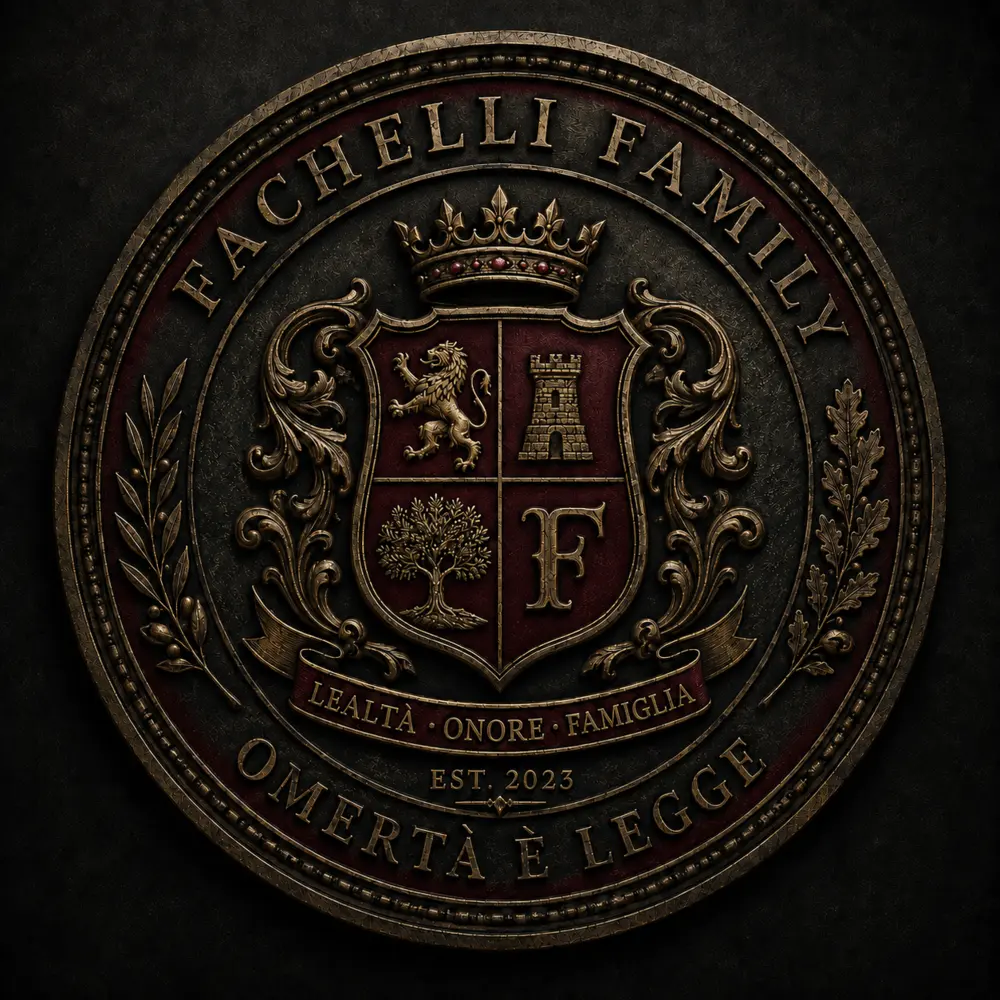
The Fachelli Family name, official seal, central brand presentation, Code of Order, core canon, and commissioned official materials form the persistent Family IP.
Local Capos, crews, members, and outside servers do not independently own or control the wider Fachelli identity, seal, history, or Commission.
Use of official brand assets must follow current style, canon, and approval standards.
Fan work and independent creator identity are welcome when they do not impersonate official statements, misrepresent ownership, or create confusion about endorsement.
02
Creator ownership and submission license
Creators retain ownership of their original work unless a separate written agreement says otherwise.
Submitting work for official publication grants the Family a non-exclusive, worldwide, royalty-free license to host, reproduce, edit for format and length, excerpt, caption, archive, and promote that submitted work through official channels.
The creator must have the rights and permissions needed for every submitted element.
A creator may request that future promotional use stop; already-published archives, credits, backups, and completed productions may remain where reasonably necessary.
Paid commissions, employment, sponsorships, or exclusive projects require their own written terms.
03
Member chat and user-submitted material
A member keeps ownership of original text or material they submit but grants the limited permission needed to store, display, moderate, and operate it within the authorized community service.
The website does not accept direct public media uploads. Official content records are created only by authorized editors and should link to approved third-party publications such as YouTube.
Do not submit copyrighted media, confidential information, another person’s likeness, or private server material without the necessary permission.
Administrators may remove content that violates policy, rights, privacy, host-server rules, or platform requirements.
Repeat or serious infringement may result in suspended or revoked access.
04
Recording and likeness
Follow the host server’s recording, streaming, voice, and content rules at all times.
Use clear channel notices, event notices, or direct consent when a production makes recording materially different from ordinary expected gameplay capture.
Respect reasonable requests involving sensitive scenes, private conversations, personal identity, or withdrawal from an unreleased feature.
Do not publish real names, locations, account details, faces, voices, or other personal information beyond the permission actually given.
Never use another member’s likeness or voice to create deceptive endorsements, sexual content, harassment, or misleading synthetic media.
05
Credits and attribution
Credit principal performers, camera operators, editors, writers, musicians, designers, developers, servers, and other material contributors where practical.
Every official story should identify date, game, server or city, chapter, characters, crew, canon status, creator credits, related business, and related storyline when available.
Corrections to material credits should be made promptly after verification.
A fictional rank does not justify removing or reducing a creator’s real contribution credit.
06
Canon and editorial control
The Commission protects Core Canon and may classify submissions as Core, City, Character, draft, non-canon, or archive material.
Local events become Core Canon only through an explicit canon decision.
Editing may improve clarity, continuity, safety, length, platform compliance, and presentation without inventing a creator endorsement.
Administrative, private, embargoed, or unreleased material may not be published without authorization.
07
Third-party games, servers, and assets
Rockstar Games, Cfx.re, FiveM, RedM, host servers, game publishers, mod creators, and other owners retain their respective rights.
Do not imply endorsement, ownership, partnership, or official status without written permission.
Use music, footage, fonts, images, code, models, logos, and other assets only under a valid license, permission, platform rule, or lawful exception.
Comply with takedown requests, platform procedures, and host-server content restrictions while preserving an internal factual record where appropriate.
08
Commercial content and sponsorships
Sponsorships, merchandise, memberships, media revenue, events, original music, and licensed creative work support the universe and its infrastructure.
Paid placement must be disclosed where required and must not be presented as a fictional order members are forced to follow.
Commercial support never purchases rank, canon control, chapter leadership, story immunity, moderation preference, or mechanical advantage.
Revenue splits, commissions, and paid creator work require a separate written agreement; fictional ledgers never substitute for one.
09
Copyright notices, counter-notices, and repeat infringement
Direct credit, permission, privacy, or copyright notices through the Contact Desk so the request can be recorded and routed.
A copyright notice should identify the copyrighted work, identify the exact material and URL to be removed, provide contact information, state a good-faith belief that the use is unauthorized, state under penalty of perjury that the notice is accurate and the sender is authorized to act, and include a physical or electronic signature.
The operator may restrict disputed material while reviewing a facially complete notice and may forward the notice to the submitting creator. A creator may provide a statutory counter-notice containing the removed material and location, a good-faith mistake-or-misidentification statement under penalty of perjury, contact information, consent to the proper federal court’s jurisdiction, acceptance of service, and a signature.
Where the statutory process applies, material may be restored after the required waiting period unless the claimant reports a filed court action. The operator may decline restoration for an independent policy, privacy, contract, or platform reason.
Repeat or serious infringement may result in content removal and account suspension or termination. Content disputes are handled administratively and never through in-character retaliation.
The Contact Desk is not a representation that a DMCA agent has been registered. Before accepting substantial user-hosted media, the operator must publish a dedicated copyright email, register a designated agent if Section 512 safe-harbor protection is sought, and keep that registration current. Direct uploads remain disabled until then.
Every character should leave a record. Every creator should receive proper credit. The archive protects both.